
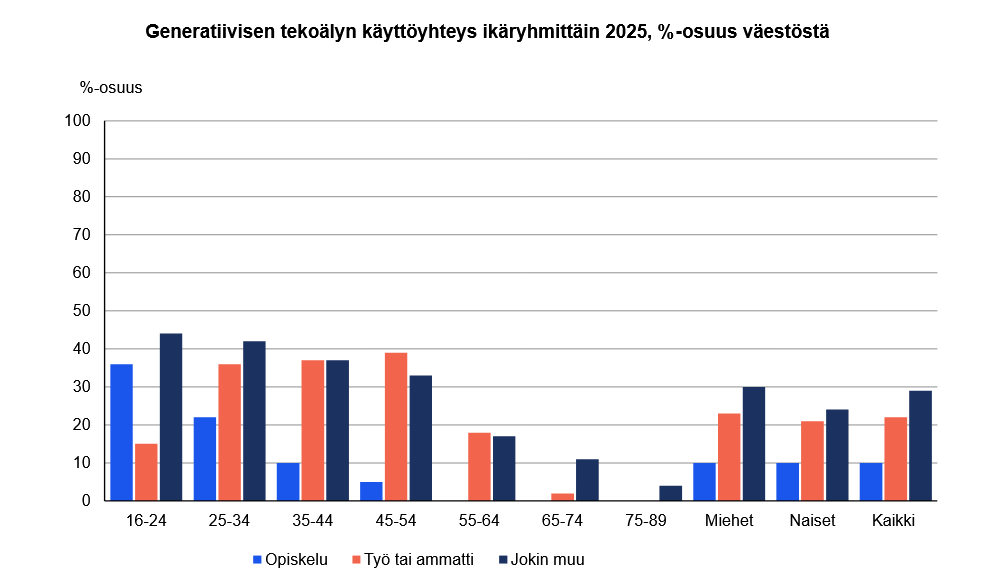
In 2025, generative artificial intelligence in Finland moved from experimentation into everyday use. According to Statistics Finland, as many as 41% of people aged 16–89 had used AI during the previous three months — almost double the share compared to the previous year. Young people in particular have adopted the technology quickly, but growth is visible across all age groups. AI is used primarily for information retrieval, and increasingly also for producing text and supporting work tasks. This development signals a clear shift: AI is no longer just a future possibility, but already a part of everyday life and working life in Finland. (Statistics Finland 2025.)
However, the rapid development of AI does not affect everyone equally. Some organizations and employees are moving quickly into experimentation and realizing benefits, while for others the technology still appears distant, difficult to understand, or even burdensome. This creates a risk of a new form of inequality in working life: skills, opportunities, and readiness to utilize AI are unevenly distributed. This article examines how the KITT – Sustainable and Human-Centered Working Life with AI project aims to respond to this change and support actors in working life in the responsible use of AI, regardless of age or gender.
What is expected from AI in everyday work?
The main objective of the KITT project is to respond to the rapidly advancing development of AI applications by helping social enterprises and organizations understand the change and adopt appropriate solutions in a controlled and responsible way. To support this, we began collecting information on the current state of AI competence in interested organizations.
Phase 1 – Mapping opportunities for using generative AI
The first phase of data collection began already during the project planning stage, when interested social organizations and actors were asked how they envisioned generative AI could be utilized in their activities.
A common feature in the responses was a strong focus on practical applications. AI is not primarily expected to deliver individual “miracle solutions,” but rather to streamline everyday work and save time.
The most prominent expectations related to information processing and analysis. AI was seen as offering significant opportunities particularly in reporting, statistical data analysis, and impact monitoring. Many organizations felt that although large amounts of data are collected, its utilization remains limited—AI is expected to help identify patterns and support data-driven decision-making.
Another clear theme concerned administrative tasks and support processes. Respondents highlighted project planning, feedback survey creation, financial administration, and work scheduling as areas where AI could reduce workload. Especially in small organizations, there was a strong need to find ways to improve efficiency with limited resources.
In addition, AI was expected to support communications and HR functions, as well as provide new opportunities in customer work and coaching. Some organizations wanted to explore and test how AI could be used directly in customer interactions, while others saw it mainly as a tool to facilitate background work.
Some responses also highlighted sector-specific needs, such as monitoring material flows and calculating carbon footprints in the circular economy, or supporting work time allocation and service development in the social and healthcare sector.
From a broader perspective, these expectations are united by the idea that AI could free up time for essential work. At the same time, many responses reflected the open and exploratory attitude also visible in the survey questionnaire: the possibilities of AI are not yet fully known, but organizations are actively interested in exploring and utilizing them.
Phase 2 – Digital survey questionnaire
The second phase of data collection was carried out through a digital survey consisting of eleven questions. The survey asked about organizations’ knowledge of different AI tools, which tools they currently use, whether they have considered adopting them, and what benefits they believe AI solutions could bring to their daily work. In addition, the survey examined concerns related to AI and organizations’ interest in participating in follow-up interviews.
The purpose of the interviews was to gain deeper insight into the current state of AI use while also helping the project plan upcoming workshops and select pilot organizations.
The survey was answered by 20 social actors and organizations committed to the project between January 26 and February 19, 2026. The main findings of the survey are summarized below.
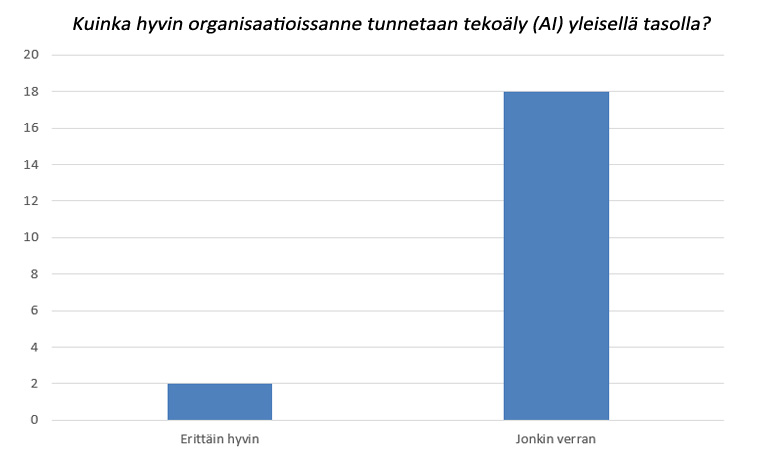
Based on the results presented in Figure 2, most respondent organizations are familiar with AI at least as a concept and feel they understand its basic principles. The options “quite well” and “not at all” were not selected.
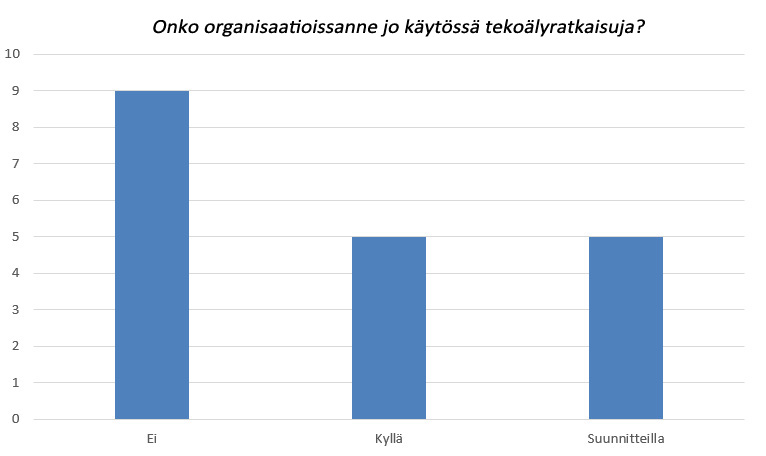
Despite basic familiarity with AI, most respondent organizations do not yet use AI solutions regularly. However, the figures presented in Figures 3 and 4 reveal that experiments with generative AI have been conducted occasionally and, in some organizations, even actively.
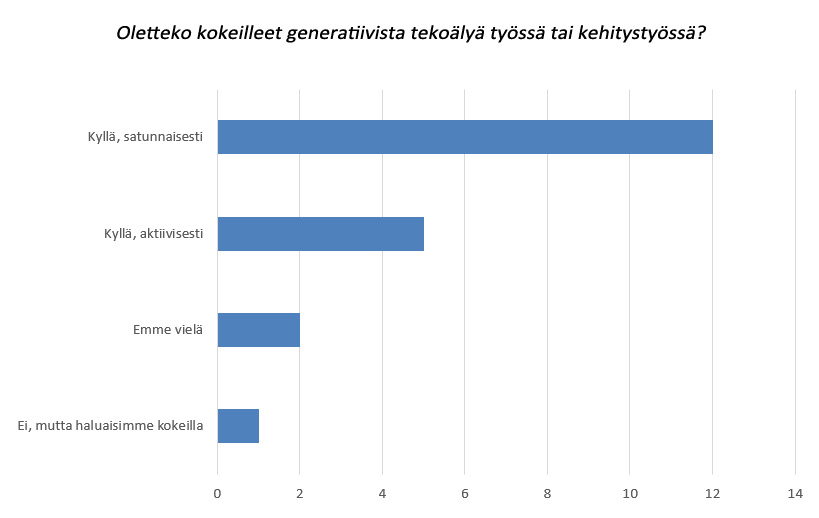
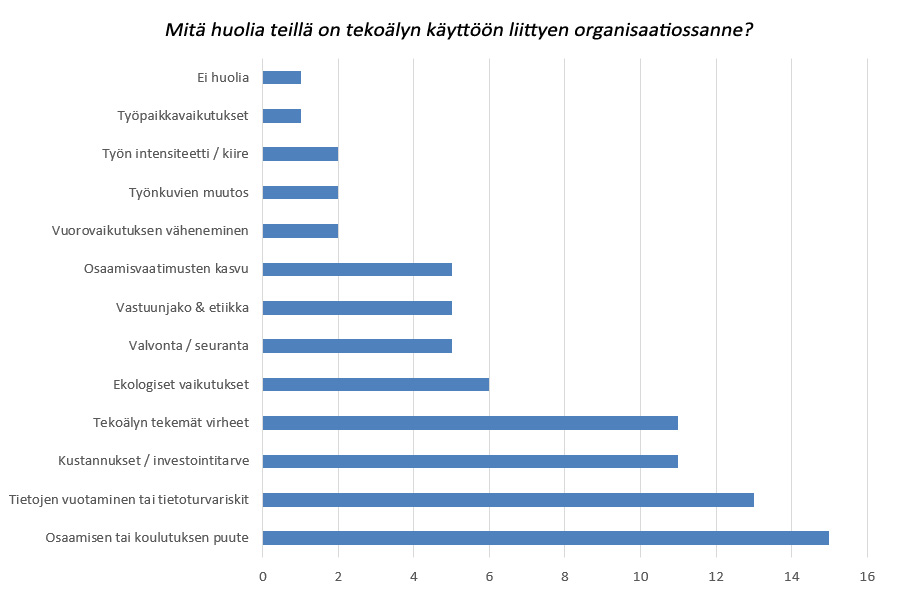
Figure 5 illustrates AI-related concerns among respondent organizations. The most significant concern is the lack of skills and training. Data security risks, costs, and potential errors made by AI are also commonly mentioned concerns according to the survey.
There is a logical relationship between these concerns and the limited active use of AI solutions: generative AI tools have not yet been integrated into regular use because organizations lack sufficient knowledge about how and in what ways they can adopt these solutions safely. However, the survey reveals that organizations are interested in developing their capabilities as users of generative AI and adopting AI solutions when it becomes appropriate and when they have the necessary readiness.
Phase 3 – Follow-up interviews
Twelve organizations that responded to the survey volunteered to participate in follow-up interviews. In the ongoing interviews, participants have the opportunity to describe their needs in more detail and specify their organization-specific expectations regarding the project’s content.
We have also familiarized ourselves with the activities of the interested organizations and considered possibilities for joint workshop activities and training programs among similar types of actors. The goal is to enable peer learning and to build shared practices that support the responsible and goal-oriented use of AI.
Based on these observations, we will further refine the project’s training and coaching content to better respond to the real needs of the target group. At the same time, we will gather material for one of the project’s concrete outputs: a shared learning model for the adoption of AI applications.
Open participation for everyone
Because AI competence should be a basic right for everyone, the project also organizes open webinars and workshops three times per year. The aim is to provide a clear and practical introduction to the topic, dismantle common myths, and create a shared conceptual foundation for the project’s future actions.
We will present a wide range of generative AI tools and guide participants in their appropriate use, while also addressing risks and limitations related to AI, as well as copyright and ethical considerations.
We look forward to deepening collaboration with the coordination project and the participating organizations. Together, we are building models for a responsible and human-centered working life in the era of generative AI—models that support smooth work processes, competence development, and equality among citizens.
About the project and why it is relevant
The long-term goal of the project is to develop new operational models based on generative AI that strengthen workplaces’ attractiveness and retention, support employees’ resources and well-being at work, and contribute to longer working careers.
The main implementer is Valo-Valmennusyhdistys ry, with Lapland University of Applied Sciences as a co-implementer. The project responds to the rapidly evolving development of AI applications by helping social enterprises and organizations understand the change and adopt appropriate solutions in a controlled and responsible manner.
Implementation, timeline, and budget
This article was produced within the Project KITT – Sustainable and Human-Centered Working Life with AI.
Timeline: November 1, 2025 – June 30, 2028
Funding: ESF+ 2021–2027 (40)
Total project budget: 601 618 €
Lapland UAS total budget: 367 958 €
Lapland UAS own funding: 73 592 €

References
Tilastokeskus 2025. Generatiivista tekoälyä käyttäneiden osuus nousi 41 prosenttiin. Tilastokeskus 31.12.2025. Referenced 23.3.2026 https://stat.fi/fi/julkaisu/cmh32zpp67l1z07w6yfukiiqd
The article publications are written by the professionals at FrostBit, related to the activities and results of the projects, as well as on other topics related to RDI activities and the ICT sector. The articles are evaluated by FrostBit’s publishing committee.

Mirka Hienonen
Mirka works as a software development expert at FrostBit. Her main focus is on full-stack development, but she is also happy to work in other roles, extending her expertise to UI and UX design, 3D modeling, and game engines.